Pricing Your Digital Design Services: Why Value-Based Pricing Beats Hourly Rates
If you are a freelance designer charging by the hour, you are actively punishing yourself for becoming faster and more skilled.
Think about it: When you first started, a logo might have taken you 10 hours. At $50/hour, you made $500. Five years later, you are an expert. You know exactly what the client needs, and you can execute a far superior logo in just 2 hours. Under an hourly model, you now make $100 for a better product.
Hourly billing fundamentally misaligns your incentives with your client’s incentives. The client wants the work done quickly and perfectly. You want to get paid a fair wage, which under an hourly model, means taking more time.
The solution to this trap is a transition to Value-Based Pricing.
What is Value-Based Pricing?
Value-based pricing means you charge based on the perceived value and financial impact your design work will have on the client's business, rather than the amount of time it takes you to click a mouse in Figma.
You are no longer selling "design hours." You are selling a business result.
If a new e-commerce website design will realistically increase a client's online revenue from $100,000/year to $150,000/year, that design is worth $50,000 to them in the first year alone. Charging them $10,000 for that website is a massive bargain for them, regardless of whether it took you 10 hours or 100 hours to build.
How to Implement Value-Based Pricing
Transitioning to this model requires a complete shift in how you conduct sales calls and structure your proposals.
1. Stop Asking "What is Your Budget?"
When you ask for a budget, you are anchoring the conversation to cost. Instead, ask about the value of the problem.
"What is the average lifetime value of a new customer?"
"How much revenue are you currently losing because your checkout flow is confusing?"
"If this rebrand is successful, where do you expect your revenue to be in 12 months?"
You must uncover the financial metric your design is meant to improve.
2. Price the Client, Not Just the Project
A logo for a local coffee shop has a different financial impact than a logo for a funded tech startup about to launch globally. The coffee shop might see a slight uptick in foot traffic. The tech startup relies on that logo to secure millions in venture capital.
The exact same design effort is worth vastly different amounts depending on the scale of the client's business. Your pricing must reflect the client's risk and potential reward.
3. Offer Options (The Tiered Proposal)
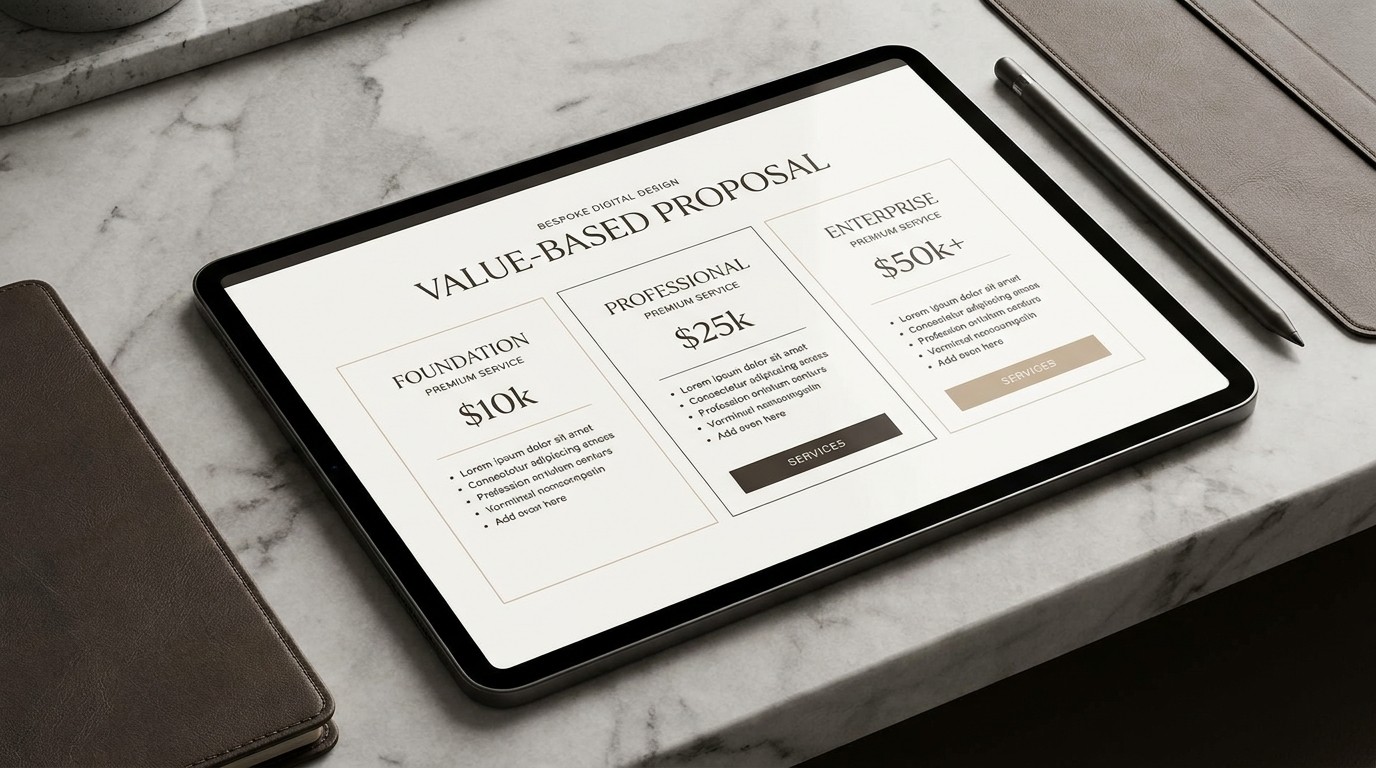
Never send a proposal with a single price. A single price forces a "Yes/No" decision. Always present three options, anchoring the price to the value delivered:
Tier | Focus | Example Pricing Strategy |
|---|---|---|
Option 1: The Basics | Solves the immediate problem with minimal extras. | 1x Price (e.g., $5,000) |
Option 2: The Sweet Spot | The ideal solution, including strategic extras (e.g., brand guidelines, social assets). | 2.2x Price (e.g., $11,000) |
Option 3: The Premium | The ultimate, white-glove service. Includes ongoing support or comprehensive motion graphics. | 4-5x Price (e.g., $25,000) |
This strategy shifts the client's psychological framing from "Should I hire this designer?" to "Which level of service should I hire this designer for?"
The Mindset Shift
Transitioning to value-based pricing is terrifying at first. It requires you to look a client in the eye and state a price that might be five times higher than your old hourly rate would have generated.
But remember: Clients don't care how long it takes you to do the work. They only care about the result. When you price based on value, you position yourself not as a disposable set of hands, but as a strategic partner invested in their business growth.
Stop trading your precious, limited time for money. Start capturing the true value of your expertise.